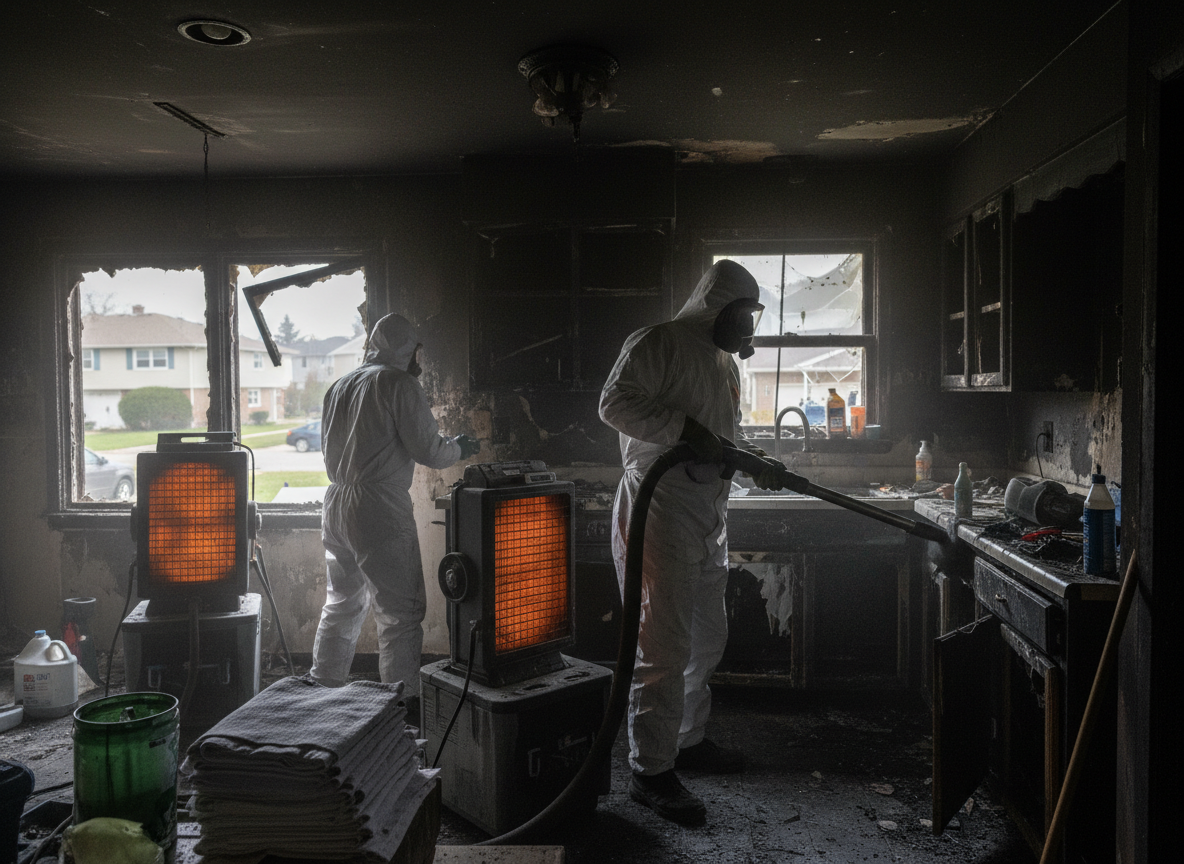
Winnetka homes built in the 1950s and 1960s often feature lath-and-plaster walls and stucco exteriors that trap smoke particulates deep into porous surfaces. After a fire, these materials require targeted removal rather than surface cleaning because residual odors return when humidity rises during the mild Mediterranean summers. Technicians working near Pierce College routinely test for hidden charring in attic insulation and underfloor cavities where embers travel through shared wall spaces in tract housing.
Dry summer conditions in Los Angeles County accelerate soot adhesion on HVAC systems, spreading contaminants to unaffected rooms in minutes. Restoration crews must isolate ductwork early, especially in homes bordering Canoga Park and Reseda where older single-story layouts allow rapid smoke migration through open floor plans. Failure to address this leads to repeated odor complaints weeks after the initial event.
Water used during firefighting can pool against concrete slabs common in Sherwood Forest neighborhoods, creating secondary mold risks if extraction is delayed. Local crews prioritize negative-pressure drying setups to protect adjacent properties in dense blocks around Winnetka Park.
Electrical systems in these mid-century homes frequently contain aluminum wiring that corrodes when exposed to acidic smoke, requiring full circuit tracing before re-energizing. Skipping this step creates safety hazards long after visible damage is cleared.
Technician insight
In Winnetka, the thing that catches most people out with fire and smoke damage restoration is how quickly smoke travels through the shared attic spaces in 1950s tract homes near Winnetka Park; homeowners often think only the room with the fire needs work, but we end up treating three or four neighboring properties because the dry summer air lets soot ride the insulation like a highway.
Smoke Migration Through Shared Attic
A kitchen fire in a single-story home off Winnetka Avenue sent smoke into the attic. We found soot coating insulation across three bedrooms and into the neighboring unit. After removing contaminated materials and running negative air for 48 hours, the odor was eliminated without affecting the adjacent property.
How it works
- 1
Site Assessment
Technicians document affected rooms, test for hidden smoke in walls and attics, and map water intrusion from suppression efforts.
- 2
Containment and Air Scrubbing
Negative air machines and plastic barriers prevent cross-contamination while HEPA filtration removes airborne particulates.
- 3
Material Removal
Porous items and heavily contaminated drywall or insulation are removed to eliminate odor reservoirs.
- 4
Cleaning and Odor Neutralization
Specialized agents treat remaining surfaces and HVAC components before final drying and clearance testing.
- 5
Reconstruction
Repairs restore the home to pre-loss condition using materials matched to original construction.
Pricing
Cost depends on square footage affected, depth of smoke penetration, and whether HVAC or electrical systems require specialized work. Upfront quotes provided after inspection.