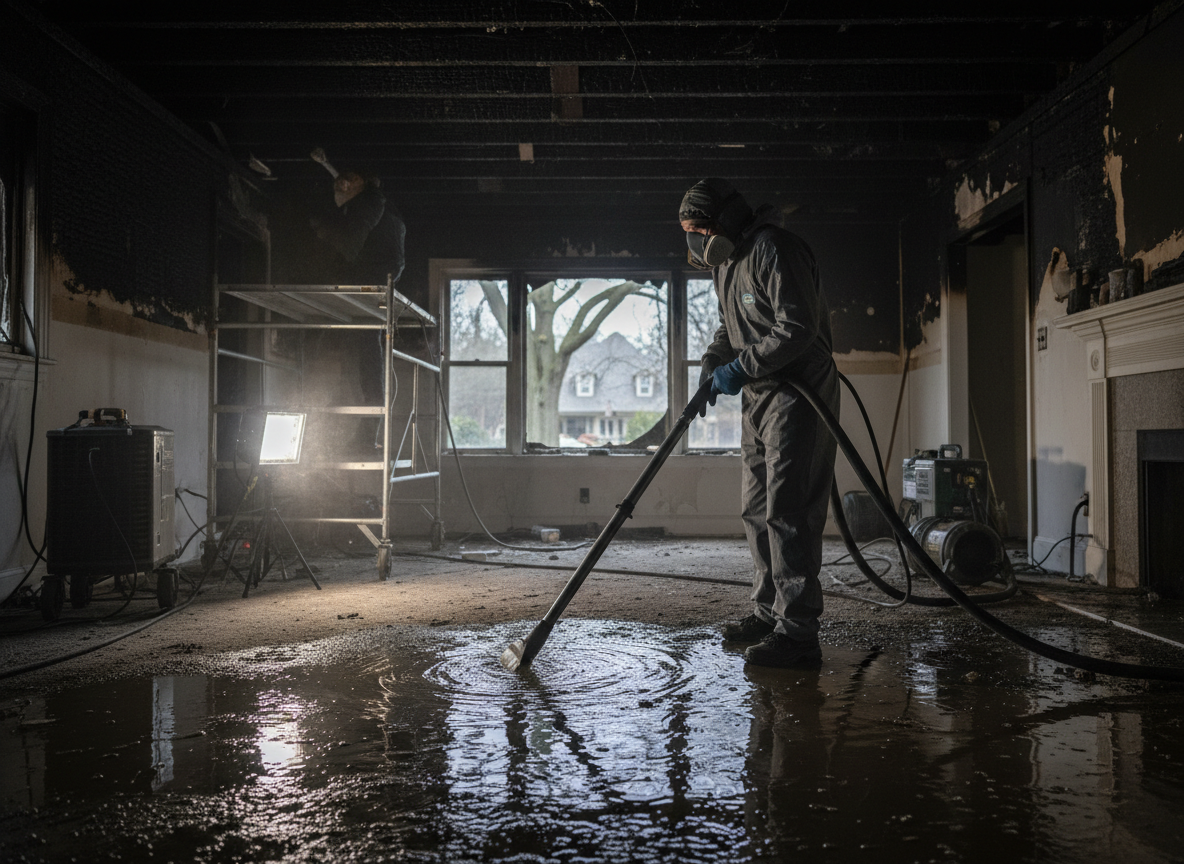
Winnetka sits in the San Fernando Valley with housing stock built mostly between the 1950s and 1970s, featuring stucco exteriors, wood framing, and slab-on-grade foundations that trap moisture after fire suppression. When summer brush fires push smoke into neighborhoods like Sherwood Forest, soot penetrates porous drywall and insulation, while winter rains can turn attic embers into hidden water pockets that reach Pierce College-area streets. Crews must separate charred materials from salvageable framing without spreading lead paint dust common in pre-1978 homes.
Mild Mediterranean summers keep fire risk elevated through October, but the real complication arrives when firefighters use high-volume hoses on older single-story ranches; water migrates under vinyl flooring and into subfloor plywood that swells and separates from joists. In Reseda and Canoga Park border homes, shared walls mean smoke travels through HVAC returns into adjacent units, requiring negative-air machines and chamber testing before drywall removal. Flooding after fire also raises the risk of electrical shorts in 1960s-era aluminum wiring still present in many Winnetka blocks.
Restoration starts with source removal and ends only after moisture readings drop below 12 percent on every affected beam. Crews document hidden char behind baseboards and in soffits because insurance adjusters often miss these spots on first walkthrough. Local terrain slopes gently toward the Los Angeles River channel, so water from suppression can pool against foundation stem walls and wick upward into stucco weep screeds if weep holes are clogged with ash.
Technician insight
In Winnetka the thing that catches most people out with Fire and flood restoration is how quickly water from hose lines migrates under the slab in 1960s homes near Winnetka Park; once it reaches the vapor barrier it travels laterally into Sherwood Forest properties and you end up chasing moisture two weeks later when the flooring buckles.
Hidden Attic Moisture After House Fire
A Winnetka single-story home near Pierce College suffered a kitchen fire that spread smoke into the attic. Firefighters used several thousand gallons of water; crews found standing water trapped above the master bedroom ceiling two days later. We removed wet insulation, dried the rafters, and replaced only the affected drywall sections instead of the entire ceiling.
How it works
- 1
Emergency Board-Up And Safety
Secure openings, shut off utilities, and establish containment to stop smoke migration into unaffected rooms.
- 2
Soot And Water Extraction
Remove standing water and loose soot using HEPA vacuums and air movers before demolition begins.
- 3
Selective Demolition And Drying
Cut out saturated drywall and insulation, then monitor with moisture meters until readings stabilize.
- 4
Odor Neutralization And Cleaning
Apply thermal fogging and hydroxyl generators, followed by surface cleaning of salvageable contents.
- 5
Rebuild And Final Verification
Replace materials to code, repaint with stain-blocking primers, and confirm no lingering smoke odor.
Pricing
Upfront written quotes provided after on-site inspection; final cost depends on square footage affected and hidden damage discovered during demolition.